Showing posts with label coffee. Show all posts

Sunday, November 11, 2012

Clever coffee filter

Clever Coffee Dripper
Not sure how new this device is but the it is called the Clever coffee filter, and for a one cup it is an interesting brew. Similar brew times to other coffee brewers, viz. 4 minutes.

See video here http://www.tested.com/food/coffee/5814-quick-look-at-the-clever-coffee-dripper/

Here is a review on coffee geek: http://coffeegeek.com/reviews/drip/cleverdripper/latest

Advantages:

  • One cup brewing
  • Filter style without a filter machine

Disadvantage:

  • is it is made from glass, not so portable.
  • Needs filter paper
  • Need a good grinder too.


Remember no matter what your brew fresh roasted coffee is always best

Wednesday, October 31, 2012

If you care interested in The Commercial Coffee market


The US coffee and tea manufacturing industry includes about 300 companies with combined annual revenue of about $9 billion. Major companies include Green Mountain Coffee Roasters (the inventor of the K-cup,  which Nestle copied to make the pods) and Farmer Bros, as well as divisions of the JM Smucker Company (Folgers), and Kraft Foods (Maxwell House). The industry is highly concentrated: the top 50 companies generate more than 90 percent of revenue.  

Globally, coffee and tea manufacturers generate about $70 billion in annual sales. The top green coffee producing countries (if you bulk together Robusta and Arabica Coffees) are Brazil,Indonesia, and Vietnam. Leading tea producing countries include China, Kenya, India, and Sri Lanka. Major companies based outside the US include Nestlé (Switzerland), Tata Global Beverages (India), and Unilever (UK).
  
Competitive Landscape

Consumer taste and population growth drive demand in the consumer sector, while economic growth of businesses, like restaurants and hotels, drives demand in the commercial sector. The profitability of individual companies depends on effectively managing raw ingredient costs, efficient operations, and effective marketing. Large companies have scale advantages in purchasing, distribution, manufacturing, and marketing. Small companies can compete effectively by offering specialized products or serving a local market The industry is capital-intensive: average annual revenue per worker is about $600,000.

Imports of roasted coffee and tea are 20 percent of the US market; exports are about 10 percent of US production. Part of the international export market is instant coffee.  

For more information please click on:
http://www.researchandmarkets.com/publication/k5c45l/coffee_tea_manufacturing

Relevance to Micro roasters?

If you are micro coffee roaster that concentrates on quality high grade coffee not sure this report has any significance. The largest exported of high grade or speciality grade pure Arabica coffee is Columbia, and they are hardly mentioned.

Tuesday, September 18, 2012

Roast Levels - how are they determined

The level to which a coffee is roasted is mainly determined by a few things
  • The actual green coffee bean used:
    • The grade
    • The variety
    • The hardness
    • Where it was grown (shaded and highland grown is what we perfer)
  • The Cultural background to coffee drinking

Bean Used

The lower the quality of a coffee bean the darker the roast has to be to extract any flavour out of the bean. One of the reasons for this is that the coffee taste comes mainly from the oils in the bean, and as you roast the bean darker more of the oil comes to the surface (it is actually pushed out almost). The better beans can be full of flavour at very light roasts. Also as you roast more of the sugars are converted to caramel. the darker the roast the more burnt the caramel.

At folk at Quaffee ensure that their coffee beans are roasted to a level where we have found them most tasty. This normally means past the first pop and no further than second pop starting. It is worth noting that the darker the roast the fresher the roasted bean has to be to fully enjoy it, since the closer the oils are to the surface the less they are protected from exposure and it is commonly known that oil exposed to light goes off quicker.

Culture

Culture plays an important part in the expectation of taste. Most cultures prefer a particular taste because it has become a tradition. The French dark roast their beans (about a 15), the Italians not as dark (about a 14). This is mainly because there is a belief that darker roasts decrease acidity. It does but it also decreases flavour, replacing delicate coffee flavours with an almost burnt toast taste. Most of Europe chooses the darker 13+ roasts. This may be related to the fact that although Europeans initially started drinking their coffees from the true source namely Africa, once the modified beans made it to Brazil, and the Robusta's were introduced in the 30's the only way flavour could be reached was to dark roast. We at Quaffee believe that these roasts are not desirable, and none of our roasts will ever go past 12, otherwise it is disposed of.

Third wave of roasting

The third wave of roasting is upon us. The first wave was dump flame and roast, the second controlled the roast a bit more, but still preferred the darker roasts the third is one that is profile driven and continually changing.

Saturday, September 8, 2012

Coffee roastery AT Buiten roastery

Same coffee different roasts
Quality control when roasting coffee, is important. So lets look at how Quaffee is controlling Quality.
  1. Coffees are put through multiple roasting profiles regularly and then tasted using cupping and traditional brewing methods. This involves taking a single coffee and roasting it 3 to 7 ways and checking while profile tastes the best.
  2. Each time coffee is roasted the profile is logged:
    • Using a profile sheet that is captured
    • Saved in a format where every 15seconds we know the flame level, drum temperature and air flow.
  3. Colour and uniformaty is tested all the way during the roast and once the coffee is cool
  4. After a coffee is roasted it visually inspected, and any beans that produced flaws during roasting removed.
The importance is that if you are going to try and source high quality coffees, you need to respect the grower by making sure your quality of roast, is the highest you can mange, and that is what they are doing at Quaffee.

Saturday, February 25, 2012

Coffee: To Freeze or Not to Freeze

When we first started getting asked about preservation of coffee, we did our own tests and our conclusion where that our coffee, roasted to an Agtron level > 50 or a Citi roast was able to retain its aroma and fragrance for approximately 2.5 months without any real loss, when kept in the freezer.

Since then we have had a number of clients and other so called ex-sperts saying now this is not the case.

Recently I found an article that was a little more scientific in its approach. I really believe it is worth a read:

You can read the whole article, but the conclusions are important:
http://www.home-barista.com/store-coffee-in-freezer-conclusions.html

Thursday, December 1, 2011

Coffee and Health?

There are many studies that have done that seem to prove coffee consumption is healthy, to the point that I am now looking for studies that look at the negative affects of coffee, and I cannot find any.

However that said here is a summary of what I can find about coffee and health, and my response to them:

  • Coffee contains caffeine (really) that is a stimulant, and to the brain look similar to serotonin, which means that people with sensitive serotonin receptors will find that instead of being told to go to sleep that single is blocked by the caffeine molecule.

    However I feel that is irrelevant since I think the most important thing about stimulants is that people who become stimulant dependent, end up in a stimulant cycle and that is the reason why they struggle to sleep or even require a stimulant to face the day. Since caffeine is one of the most accessible stimulants, and the most socially acceptable besides say sugar. The irony is that most people who require coffee to wake up also require an additional stimulant that compounds the effect of caffeine.

    The best rule of thumb is to remove the most obvious stimulants from your early morning diet. By doing this you prevent getting caught up in a daily stimulant cycle. So coffee (and all stimulants) should only be consumed 1 hour after you have eaten breakfast at least 4 out of 3 days.

  • Addiction? This is linked to the stimulant cycle. And it is easy to break. Simply go off coffee for 5 days, if after 2 days you get a head ache then you are addicted. Once you have completed the 5 day, start only having coffee after breakfast.

  • Association: this is probably the hardest one to argue for or against. Like cancer sticks after org@sm once you have an association it is hard to break. To break it you need to fight it for as long as it took you to establish it. Associations are hard wired in the brain, so you need to break the hard wiring. the wiring is done by linking neuron in a network, the stronger the association the strong the pathway is linking the neurons that remind us of the sensory experience we have as part of the association.
So here is my challenge anyone a study of actual coffee and either its short or long term affects that are negative place a comment here so I can also read it and publish it.

Tuesday, November 22, 2011

Spanish Coffee?


This article on Spanish coffee looks at the history of Spanish coffee and how Spaniards today have integrated coffee into part of their way of life and culture.

It takes a look at the various different types of coffee so that when you go into a bar or restaurant in Spain you know what to order.

Spanish roast is normally a dark roast. The Spanish have a similar history to the Italians when it comes to blending, having become the driven to get great coffee when their coffee bean supplies dried up in the own internal wars and involvement in the various European wars.


The typical though of Spanish coffee is a steaming mug of coffee with rum or other
alcohol and topped with whipped cream, but the Spanish influence on the coffee industry
reaches much further than the bar in a ski lodge. The classic coffee cocktail is as follows;
3/4 oz. 151-proof rum
1/2 oz. triple sec (Huber’s uses Bols)
2 oz. KahlĂşa
3 oz. fresh-brewed coffee
Tools: lighter or matches
Glass: sugar-rimmed red wine or Irish coffee glass (make sure it's tempered)
Garnish: lightly whipped cream and sprinkling of ground nutmeg

Add the rum and the triple sec to the sugar-rimmed glass and carefully ignite. Add
KahlĂşa (the flame should go out at this point), top with hot coffee and Garnish.


Before our time Spanish ships carried coffee plants and seeds to many remote areas of
the world where coffee was not native but soon became central growing hubs.

Descendants of Spanish conquistadors settled in Central and South America where they
created huge plantations for growing Spanish coffee.

It is said that coffee originally came to Spain through Turkish immigrants. Not much, if
any, coffee was actually grown in Spain but they developed a method for roasting that
produces very dark, almost black oily beans that make very strong coffee that is known
as Spanish Roast, or Dark French Roast.

Spanish coffee growers in Latin America accounted for nearly half of all the coffee
exported; however, most Spanish coffee served in Spain comes from Angola and
Mozambique and is roasted dark to bring out the full flavour.

Early Arabic coffee traders tended to gouge the Spanish coffee merchants on pricing and
the result was the highest priced cup of coffee in Europe. Portugal, Spain’s neighbour,
had colonies in several coffee growing regions in Africa and sold coffee to the Spain at
more reasonable prices, however the quality was not as good and some importers chose
to pay the higher prices for the Arabian coffee.


THE DIFFERENT TYPES OF SPANISH COFFEE 
When you are in a restaurant or bar in Spain you can order many varieties and types of coffee. Here are the most common:

CafĂ© Solo - the most commonly ordered type of coffee in Spain. CafĂ© solo is a small and very strong black coffee usually served in a small glass.

CafĂ© Con Leche - is the next most popular way to drink coffee, especially as the first cup of the day. It is half cafĂ© solo and half hot milk and can be served in a small glass or a tall thin glass.

CafĂ© con leche is best drunk in a traditional Spanish bar where they pour the milk into a metal jug and then with steam from the espresso machine they noisily froth the milk and heat it up so your coffee will be piping hot!

CafĂ© Bombon - this is a variant on cafĂ© con leche, it is a small glass containing condensed milk with a cafĂ© solo slowly poured in. It is then mixed and is very sweet tasting.

CafĂ© Americano - similar to a cafĂ© solo but served in a larger glass or cup with a more water.

Café Cortado - a strong black coffee similar to café solo but with a drop of milk.

CafĂ© Con Hielo - mostly drunk in the summertime this is cold coffee otherwise known as iced coffee. The Spanish will serve you with a 'normal coffee' and a separate glass with ice and you should then pour your coffee over the ice.

CafĂ© Sombra or CafĂ© Manchado is mostly milk with just a few drops or small measure of coffee.


CafĂ© Carajillo - this is the coffee that is famous around the world as 'Spanish coffee' although as we have already seen - there are so many other types of coffee in Spain apart from the cafĂ© carajillo. Outside of Spain we know Spanish coffee as a coffee with alcohol - typically rum then topped with whipped cream.

In Spain a traditional café carajillo is a café solo with a small measure of brandy.
Alternatively you can have rum or whisky instead. If this is done properly the brandy is
lit first so the alcohol burns off then the coffee (solo) is added.


dited by N. Pink, source: http://www.costablancauncovered.com/living-in-Spain/food-and-
drink/Spanish-coffee.html




Wednesday, November 16, 2011

What is the best coffee?

I regularly get asked what is your best coffee, or what is the best coffee, our standard answer is that all choice is subjective.

Popularity is one measure, but this is misleading, since most things that are popular are actually a good enough quality but not the best. Take anything, clothes, wine or cars. The most popular product is never the one that is the best quality, it is the one that has a stronger price to brand performance perhaps.

There are also many standards in coffee the two most common as far as quality of the raw bean grading is concerned are the African standard which is to list coffee as Grade 2 (since Grade 1 is not allowed to be exported), and AAA, AA or AB. Unless the coffees have been externally graded this actually means very little.

Grade AA means that in a crop that was the biggest size, and size is not always a good measure for quality even if there is an actress and a Bishop involved. In fact the smallest grade Pea berry normally is a better grade than the AAA grade.

There are however three trustworthy ways to judge a coffee before it is brewed:

  • The cup of excellence or COE, which is a competition that is run once a year, then the winning coffees can have boasting rights, this however only includes the South American coffee growers at the moment, so it discounts the largest growing area of Equatorial Africa (and home of coffee), there is some inclusion now by African countries are not listed a full members yet.
  • Micro lot auctioned coffee, this stuff is very scarce in South Africa, and the coffees are cupped each week, micro lot coffee represents a portion of a growers produced that is represented as the best week of a harvest. Micro lot coffee is always listed as such
  • The most important is that you judge it yourself. We have a thing that we use called the drink-ability index. Once we have finished tasting a coffee we see how fast we consume the rest of a sample, if the sample is drunk quickly then it has a high drink-ability index, if we find that the next days we still have some left then it has a low drink-ability index. Why not try it yourself. You do need to be a big consumer though, we drink between 5 and 20 cups a day depending on the drink-ability of the coffee.


Friday, October 28, 2011

Italian coffee blends the TRUTH they are the ultimate invention

It amazes me how many people believe that coffee blending is a special art that only the Italians can get right. Unlike wine where the French learnt the art of blending by using the best local produce. Italy DOES NOT, and never had grown its own coffee.

Coffee Blending started out of a necessity of lack of supply. Italy in the 18th century was not a country, it was a collection of city states. From WIKI "Despite a lack of consensus on the exact dates for the beginning and end of this period, many scholars[who?] agree that the process began in 1815 with the Congress of Vienna and the end of Napoleonic rule, and ended in 1871 with the Franco-Prussian War. The last cittĂ  irredente however, did not join the Kingdom of Italy until after World War I."

This means that from 1815 essentially Italians favourite brew had limited supply. The Dutch, British and Spanish controlled the import and export route, the glory days of the Venetians controlling trade in the Mediterranean were long gone. Between them and the Turks they had introduced Italy and Austria to what was the worlds biggest brew.
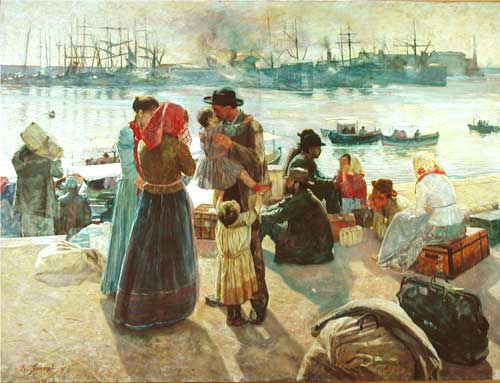
The poverty in Italy in the 1800's caused mass 
emigration

So necessity being the mother on innovation, people started blending whatever they could to try and get the coffee they loved. And the blended all sorts of things to try and get a great coffee. Where before they had been able to relay on high quality coffee from the Dutch and Venetian importers, their choices where limited.

Add to this that at the same time the largest coffee growing regions started identifying that coffee grown in plantations rather than in highland forests suffered from coffee rust, and the coffee quality was been affected anyway.

So you have contributing factors:

  • Italy is at war with itself, the Austrians, and the French, rations and imports are limited in the first place
  • The quality of world wide coffee is being affected by the mass replanting of crops to be replaced by a lower quality but more robust distant cousin named Robusta, or Robusta Arabica cross breeds.
  • The coffee culture at this point was quite strong, the Austrians and Italians driving demand in main land Europe, feed by the Dutch and French importers
Now wonder all of the most establish blends of Italy come from this period. When I see that a company that claims to have been blending since this time, red flags go up and I think to myself what have these companies have a reference point?

Blends are a way of getting a similar tasted no matter what happens in the year before with regard to agricultural results. Perhaps we should be asking ourselves what are we voting for when we support these products with our money?

Is a crop ever the same year on year? No, blending is not an art of taste it is an art of marketing.

Saturday, October 22, 2011

Can an espresso filter change a brew?

I recently saw an advert for a machined espresso filter. I have always wondered how you can tweak and espresso machine, and seeing this is quite interesting. Can the size of the holes make that big a difference?

Well read what coffee geek had to say: (original link Can These Filters Change the World of Espresso?) VST Baskets Here is a summary.

Driven by an idea in a lecture VST redesigned the fitler basket to produce their own one, producing three different basket sizes. But it's not just the physical size of these baskets that are different: the holes, their size and placement are given extreme attention for each individual basket size. The four sizes are: :
  • 7 gram basket (still in development, not yet available);
  • the 14 gram basket (VST will call this a 15g basket, as it can hold 14-16g);
  • the 17 gram basket (VST ref 18g - can hold 17-19g);
  • and the 21 gram basket (VST ref 22g, holding 21-23g).


3 VST baskets
  1. One of the things learned was the value of around 1-2mm separation (depending on the type of coffee used, but leaning towards 2mm) from the top of the bed of coffee and the bottom of a dispersion screen. For many testers, this was deemed the optimum clearance to allow for full and complete saturation of the bed of coffee. The vertical depth of each basket is designed with this 2g max swing in weight while still hitting desired target extractions as shown with an ExtractMojo refractometer test and Mojo's Brewing Control Chart.
  2. Water flow through the bed of coffee was also exhaustively examined. Existing baskets, with a much smaller exit surface area vs a larger entry area on top for liquid often result in uneven, sometimes unpredictable extractions. The answer would be to maximize the bottom flat portion of the basket, with as many holes as possible to the edges. This is one thing the VST baskets do.
  3. Other baskets have inconsistent holes sizes, and this produces grinds in the espresso and blockages, so the VST baskets solve this through a patent-pending (and protected) manufacturing and testing process. Where most baskets have a wide spread of sizes for holes (sometimes as many as 200 different hole sizes in one filter), the VST baskets, by contrast, 3 to 5 hole size spread for almost every exit hole in the filter. They are just that uniform, and that leads to better, more even extraction possibilities.
The baskets do make a difference, but the also expose bad tamping techniques


Update:
Okay so they are not VST porta filter baskets but while in Seattle I picked up the Strada ones, one getting home, and making sure my tamp was correct, I was really surprised how a small difference can change so much, the espresso was much better extracted, crema at least 50% better, and the espresso tasted good.

So if you cannot lay your hands on the VST porta filter baskets, then try a La Marzocco agent and ask for their baskets. They really do improve the expresso you can pull.

Thursday, September 22, 2011

Why do some people drink milk and sugar in coffee?

Many things have come from war, not all of them bad. Funny place to start when talking about why we have a tradition of some cultures adding milk and sugar to their coffee.

Well the person who is often recognized as the person, who was coffee’s chief promoter of coffee in Europe Yuriy Kulchitsky, was originally a Cossack from Ukraine. Fought against the Turks and was captured. While he was captured he was introduced to coffee (the wine of the Turks/Arabs), and he also taught himself Turkish.

In the mid to late 1600’s he worked as an interpreter in Vienna. In 1683 Vienna was besieged by the Turks. Kulchitsky dressed in traditional Turkish apparel and was sent to request reinforcements from Emperor Leopold. These reinforcements assisted in the emancipation of Vienna, and Yuriy was hailed as a hero.

When the Turks retreated they left 300 sacks of coffee and these where given to the only person
interested in them Yuriy.

He started handing out coffee so that people could taste it, and driven by his passion decided to add milk and sugar to the coffee, so that more people would enjoy the coffee. This resulted in the opening of the first coffee shop in Vienna (one of the first in Europe, the Venetians lay claim to be the first).

If you visit Vienna there is a monument to Yuriy Kulchitsky and there is a street that bears his name. A rare honour for a lover of coffee, to have achieve such fame.

To this day coffee is still enjoyed in a Viennese style (with milk and sugar), although some traditionalist consider this sacrilege.

Tuesday, September 13, 2011

Coffee the biggest gainer in the Standard and Poors

Coffee was actually the biggest gainer in the Stan...: Last month Arabica futures rallied 20 percent on the news that frost in the Brazilian growing areas would negatively affect next year’s crop. Coffee was actually the biggest gainer in the Standard and Poors GSCI Index, and the GSCI was down 1.7 percent! Arabica Coffee had more than doubled in price since June of 2010. Rain had cut the output from Colombia, the second largest producer. And according to the U.S.D.A; Coffee stockpiles in Brazil were at their third lowest level in fifty years.

But if you look past this news, and read the additional information in the above linked article, you see that a momentary scare is all it is. The future looks like the coffee prices will decrease over the next 12 months with production in the major South American countries on the increase due to both weather and financial drivers.

Friday, July 29, 2011

Sensual coffee roasting

The Art and Craft of Coffee: An Enthusiast's Guide to Selecting, Roasting, and Brewing Exquisite CoffeeWhen you are serious about extracting the best for a high quality coffee, you need to roast considering many things. The two  most important senses are sight and smell. Yes there are electronic devices and timers and temperature gauges but the best roasters use those the most, and sound is an element too, since with sound you identify first crack (pop) and second crack (snap). Those are great guides to the point at which the coffee is roasted.

Imagine losing one of those sensors and still roasting? Well read this and it may open your eyes.

Tuesday, May 31, 2011

Coffee Quality what what you buy


Essentially, the article summarizes what is happening in the coffee market. When brand is more important than quality is the brand worth anything?

Coffee roasters have for years considered profit above all. When they could not procure product at prices that would mean they make super profits they are used too.

A quality brand puts quality coffee as the only driver to their coffees, is a rare find.

By blending coffee with lower quality blends lowers the quality of the blend, so to call a blend 100% coffee is another way of saying we cannot guarantee the quality. Remember that there are over 100 varieties of Arabica alone, never mind the Robusta varieties. Also remember that coffee is a crop and you get different quality crops.

Take all that and you realize that pricing and quality are linked. That said on the high end, sometimes there is good value. A good example is Yirgacheffe versus Los Naranjos. The one came 3rd in 2009 in the world wide ratings (Yirgacheffe) and the other 1st, but the one is half the price of the other.

Tuesday, May 24, 2011

How to tell if a green bean is quality --- the roast

Coffee as we know it goes through a few processes before it is even roasted. It is fermented (either using a dry or wet process) and then de-pulped and then it is a state know as green bean. Many years ago this is where the process stopped, it was mixed with fat and chewed. If you have ever tasted a green bean you will understand why this did not become a world-wide hit, as its roasted cousin eventually did.

When coffee is roasted, a number of things happen inside the bean that essentially is summarized as water being forced out of the bean, and the bean then goes from a light green to an amber and then light brown then darker brown. When the internal temperature of the bean reaches about 200 °C it goes through a process that is called the first pop. This sounds like pop corn popping, as the water and other molecules are forced out. At this point it starts it a process that exposes first floral, then fruit then herbal (see wheel). The finest coffees can be roasted into the nut and chocolate areas by a skilled roaster, the lower quality bean need to go through that process dry distillation areas for flavours to be exposed.

What is often forgotten is the reason why some of these darker roasts are now called their well know names. Namely:

  • Italian
  • Austrian
  • French
  • Portuguese
So what was the reason. Well look back at the history of roasting and blending. Blending became an art when the coffee lovers of the above countries could not get access to the finer coffees, because of crop failures and war. Three things resulted:
  1. Roasts where extended to find flavour in lower quality product
  2. Other products where found and roasted with the coffee - the most popular was and still is the Robusta bean
  3. A combination of the 1 & 2, and the blend and blend master was born.
The blend master strived to get the same nuances that a single origin high quality coffee would produce on its own.

Now of course these blends rule the roast or is that roost. Since they became well know. A coffee company today has its hand forced to produce a blend. Like wines and whiskeys the most famous wines and whiskeys are blends. But the real lover of coffee is slowly re-discovering the beauty of a coffee that is a from a single grower or area that produces a great coffee. Some years it is excellent, some years okay.

If you love coffee start looking for these coffees...

Wednesday, April 6, 2011

Brewing Fundamentals a great guide

There are many ways to brew great coffee, I found this an interesting read:

With wine the wine maker has complete quality control up to the time of bottling - coffee however requires that the consumer use a bit of their own craftmanship during preparation. There are a number of variables that can ultimately ruin a cup of coffee - temperature, weight, extraction time, etc.


The Coffee Brewing Center (CBC) looked at a number of factors to try and remove the guess work in producing the perfect brew. Led by Dr. Earl Lockhart, in the 1960's, their research has become thee body of knowledge in truly understanding the physics and science behind coffee brewing.

Before discussing the fundamentals its important to define some basic brewing terminology, namely: strengthextraction and brew formula. Together these three variables make up the building blocks of what creates aroma, taste and body in coffee.


  • Strength refers to the measure of solubles present in the beverage and usually expressed as a percentage of the flavoring material to water
  • Extraction or sometimes refers to as "solubles yield" - refers to the amount of solubles extracted from the bean itself and also expressed as a percentage.
  • Brewing formula refers to the ratio of water used per quantity of coffee.

Brewing Control Chart
Much of Dr. Lockhart's work at the CBC was dedicated to the creation of the "Coffee Brewing Control Chart" which is still in use today. In essence, the brewing control chart provides a graphical representation of strength, extraction and brew formula in an easy to read format.

By measuring the soluble coffee flavoring content in brewed coffee relative to brew formula, the CBC was able to graphically represent "solubles yield" given the coffee to water ratio. This provided the industry with the framework in which to discuss and compare coffee quality.

To determine any one of these variables simply select a brew ratio (depicted as diagonal lines on the chart) and beverage strength or extraction can easily be extrapolated. This is discussed  in greater detail below, but for now, one important thing to remember is that, according to the CBC, the best cup of coffee is obtained when approximately 18-22% of the flavoring material is extracted from the bean. As such, this infusion would represent a beverage with a corresponding strength of 1.15-1.35%. When both these factors are met, the beverage is said to be at its "Optimum Balance" and is depicted as a grey box in the center of Brewing Control Chart.
SCAA Brewing Control Chart
Image
Click for larger view (pdf )


Strength (solubles concentration)
The amount of flavouring material contained in a beverage will vary depending on brewing method used. Typically a drip cup of coffee contains roughly 1.2% flavoring material and 98.8% water. Whereas, a typical espresso will contain on average a flavouring concentration of 1.8-2.2% and ~98.2% water. Making coffee is a potent flavoring material.

Luckily, strength measurements can be made relatively easily using a number of different instruments. The most common include the use of hydrometers, conductivity, brix and and moisture microwave. Since their relatively cheap, TDS or - total dissolved solids - are the most commonly used in the industry. For all practical purposes, a TDS meter is just a customized conductivity meter that relates the amount of coffee flavoring material based on its conductivity across a coffee infusion. For example, a reading of 1800 TDS refers to corresponding flavoring material content of 1.8% and 98.2% water on the Brewing Control Chart.
Figure 1: Strength
Image
Click for larger view
Extraction (solubles yield)
Approximately 28% of the organic and inorganic material in a coffee bean is water soluble. The remaining 72% of the material consists on insoluble cellulose which serve as important structural components for the bean. Upon the addition of hot water much of the soluble material readily dissolves to create important flavor and aroma compounds in the cup.

As shown in Figure 2, a 20% extraction (shown at the bottom of the chart) indicates that 20% of the soluble flavoring material was dissolved in water. For example, if 10 grams of ground coffee was used in brewing, the bean would have lost 2 grams of soluble material to water. Because the rate at which these soluble compounds dissolve vary, changes to grind, water temperature, brew time, coffee weight and brew equipment will invariably produce vastly different beverages. For example, extractions below 16% produces a beverage with a weak peanut-like flavor, while extractions over 24% producing over-extracted bitter characteristics. Well discuss this subject in other sections later.

For now, the key is to brew coffee within the "Optimal Balance" having 1.15-1.35% coffee flavoring material.
Figure 2: Extraction
Image
Click for larger view
Although it may seem intimidating at first, using the Coffee Brewing Control Chart will provide for the basic groundwork in which to ensure consistent beverage preparation.


References:
Lingle, T. The Coffee Brewing Handbook. SCAA


Edited version of the originally found at: Brewing Fundamentals. | Brewing | Quality

Wednesday, March 16, 2011

Your coffee is great, (but still no order)

I was once told by a colleague that puppy dog marketing is the most effective form of marketing. You give someone something they love and then they want to keep getting it.

Well if that is the case the question I ask the is over the last month we have given samples of our coffee to a number of people, everyone of them have come back to us saying the coffee is great. Of those two of them then carried on ordered from the person they had ordered from, and did not even blink.

Do they think our brand is so exclusive? I am blown away by how people make decisions. Anyone out there got an explanation?

Tuesday, February 22, 2011

Coffee and Packaging and storage

Over the many years that I have dealt with coffee, I have found the it amazing how illogical coffee packaging can be.

Firstly let me excluded any type of instant packaging (including  instant coffee, pre-ground, pods, etc), these are designed for convenience and if you are a lover of coffee these should not be put in any category of coffee. I am talking about coffee beans only here.

So what types of packaging have I seen, and what are my comments:

  • Tins, these are great if you are using the coffee in the next 7 days, otherwise they are a fashion accessory. Yes some fancy pancy products come with seals and they have some sort of Nobel gas in them, but even if the gas can survive for longer than 2 weeks, once the tin is opened the coffee gets flat quicker and 7 days is an absolute maximum
  • Foil bag, this is another of these fashion things adding a non-return valve is also a great gimmick, convinces those who are impressed with blumph that they do something, best case they will keep the coffee fresh for about 10 days, but after that no thanks may as well put it in  a Tin.
  • Vacuum pack, seriously now think about coffee gives off gas if it is fresh, so can this work NO, marketing crap
  • Freezer Bag, this is probably the most effective, and if the coffee was not murdered when it was roasted then it will survive perfectly well in the freezer for between 2 to 3 months (depends on the roast level, and how often it is taken out of the freezer)
After the tests we performed, what where the conclusions:
  • Fridge is worse than cupboard, especially if cupboard is dark
  • Freezer only works if the oils are not exposed to the surface on roasting, otherwise the stuff should be thrown in the bin anyway
  • Freezer bags work best in cupboards, and the freezer. Coffee straight from the freezer into grinder performed as well as stuff left to return to room temperature.
And the best thing is that if you are seriously interested in reading properly written articles than these claims are substantiated many times over.

Monday, February 21, 2011

Ethiopian Export news, commentary

Coffee Story: EthiopiaWith Ethiopia being of significance when it comes to specialty coffee, I do try and look for anything interesting about the country, and so I found: East Africa Forum » Coffee vs non-coffee commodities: "Ethiopia’s annual exports recently reached a never-before-seen level of USD 2 billion, a growth of 38 percent from the year before."

In this report there is good news exports are up 38%, and the largest importer of Ethiopian commodities is Switzerland, which is interesting, as that is also the capital of decaf coffee production.

So items of interest:

  • Ethiopia now has five major non-coffee exports (oilseeds, gold, khat, flower, and pulses)
  • Exports of goods in Ethiopia are only about 7 percent of the Gross Domestic Product (GDP), compared to an average of near 30 percent of GDP in Sub-Saharan Africa.
  • Coffee continues to dominate the top spot among Ethiopia’s exports but its relative significance is now at a historic low


Thursday, February 17, 2011

South Africa drinks 20% less than the world average

So according the the website Current Worldwide Annual Coffee Consumption per capita, South Africa drinks 20% of the world average when it comes to coffee.
Coffee; From Plantation To Cup. A Brief History Of Coffee Production And Consumption. With An Appendix Containing Letters Written During A Trip To The ... The Coffee Consuming Countries Of Europe
Are we serious that much into beer? I also read today that they claim that 60% of the coffee in South Africa is drunk in the workplace. Workplace coffee however is mostly instant at the moment.

There is a slow move towards a higher quality coffee, but the majority of coffee drinkers in South Africa think quality coffee is filter coffee. On that most filter coffee is purchased as pre-ground (yuk), which is the same as buying you coke open and two days old. If you vacuum pack two day old coke does it taste any different?

But I digress, lets go back to numbers. 66% of all coffee drunk in South Africa is instant, the other 36% is brewed coffee. Of that at least 90% of that is pre-ground, which means that 3.6% at most is in bean form. Excluding the specialty coffee market this means that only 710.4 metric tons of coffee are sold in their finest natural form, i.e. in beans.

What does this mean? Well that serious coffee drinkers in South Africa drink less than 1% of the world wide average.

Perhaps I have something funny in my cup, but these figures are strange. I may not drink 19,733 tons a year, but I get close to 10kgs a year, and that is above the Norwegian average :)