Tuesday, March 25, 2014

Jura F8 available in South Africa

Jura Impressa F8 TFT

Quaffee Jura authorised dealer authorized agent
The next one up on our best in the range choice! Adding a TFT screen to an already great machine for a small difference in price. So you get all the features you need in a great package, for a great price.

The F7 has proved what a great coffee machine it is, and now it has a screen to help and make it more user friendly, easier to use. With guides on how to do tasks that used to make you run for the manual this is the most affordable Jura with a TFT screen.
This is the first time that a TFT colour display has been available in JURA’s compact class. Operation using the Rotary Switch is easy and clear. Four speciality coffees can be individually programmed on the start screen, allowing you to prepare your favourite coffee with a single button press.


Jura Impressa F8 TFT new

Features at a Glance

  • 4 programmable buttons, 2 with double dose features
  • TFT Display for easier use
  • Rotary Switch
  • Cup illumination
  • Cup count
  • Display for easier operation
  • Powder shaft
  • Aroma preservation cover
  • I.P.B.A.S.©
  • full power shut off, using less than 1W/hr
  • Proven fine milk frother
  • Aroma+ grinder for better extraction
  • Height-adjustable coffee spout 65 - 111 mm
  • 1.9 litre tank, without filter 2 litre
  • 28.5 x 35.5 x 44.5 cm

Frother near spout

TFT Screen

Aroma+ Grinder

The new design on the Cappuccino frother foaming of your milk to produce new Barista style micro foam, the perfect milk foam guaranteed for an enjoyable cappuccino and latté experience, now right next to the coffee spout. The TFT screen make programming and use easier. You can scroll through options or be guided through tasks. Add to that the four programmable buttons for easy and quick access. The new grinder is designed to be faster and improve the taste. A more conical design feeds the beans at the correct rate making sure the burr grinder is more efficient.
Jura F8 Milk Frother Jura F8 wide range of programmable options Jura F8 grinder and beans

Further Info

F8 Technical Data Read all about it! In PDF form you can read the full technical spec here F8 Instruction Manual, or want a sneak peak here you go

Friday, June 28, 2013

Trouble Shooting Diedrich ignition, a documentation of a support call

Trouble Shooting ignition, a documentation of a support call a log of the call

Q:

Let’s test the Dungs vacuum sensor. If you remove the clear cover, you can turn the dial and change its sensitivity. Mark where it currently sits before you move the dial. It should be set at 0.3 but try moving it to 0.2 or 0.1 and seeing if your roaster will light. If it does, that will tell us that you have an airflow restriction somewhere in your roaster. If not, we may need to replace the vacuum sensor. The little plastic/rubber tube that comes off the Dungs valve and connects to the tube that hangs down in your blower housing should also be checked to make sure it’s completely clean. Let me know what happens. Dungs Vacuum sensor

A:

We actually connected the 2 brown wires together in the sensor today as the fault finding guide says to do. But I have done as you asked and still nothing. I tried it at 0.1 and 0.08 still no spark

I disconnected the black tube too and I can blow or suck through it fine

Q:

You also checked the aluminum tubing that hangs down in the blower compartment? If you’re sure everything is clean, we can try replacing the vacuum sensor and seeing if that fixes the problem. I’ve attached our guide to narrowing down where the issue may be. Do you already have this guide? (see below) It says if you’re not hearing the clicking, to check to make sure your high limit unit is functioning. We should try to rule out as much as possible before we replace any parts.

A:

This is the one we used, we go through it a few times. This is the guide that says to take the vacuum sensor out of the loop by connecting the 2 brown wires, we did that and it made no difference, so surely it is on the sensor? I checked the tube, blown through it and sucked through it. The roaster is clean we are fussy about this. The automatic machine reset the high limit when you power on the roaster. I am not how else to reset it. I am not sure where the Watlow thing is positioned.( Turns out it is next to the Abbey Electrical Igniter, with jumpers labeled

Q:

With the blower on, take a continuity reading between commonly open and common to make sure we’re getting power there. If yes, then the ignition controller may need to be replaced, if no power, then the vacuum sensor needs to be replaced. Let me know what you find. Check for power at these two connections on your Abbby ignition controller. AbbeyElecticalIgnitionController

A:

Did this and use the wiring diagram to determine the startup was stuck at the vacuum sensors. Looks like shorting out the wires did not help. When we blew into the pipe it then worked. Found a blockage in the outside chimney.

Lessons from Trouble shooting the IR12 Ignition problems

In an effort to share the knowledge gained, and to document for our own use here is a trouble shooting summary of how we solved the Ignition problems. We used a number of documents that are available at different places on the net, so there is a list:
There are also some videos we posted under the equaffee youtube account

So essentially what did we do?

We removed the side panels to expose the Abbey Electrical Ignition controller and Dungs vaccum sensor on the right. Using a meter we tested that current was coming in as per the Fx4 diagrams. The using the diagram we check that each item from the startup was happening as required. During this process we identified that the vacuum meter was not feeding back a ready message. We then disconnected the silicon tube that was going to the aluminium tube in the fan hosing and blow into it so that the vacuum meter identified that there was a vacuum.

This then solved the problem, well at least pointed us to the reason, soon we were roasting great coffee. Sounds easy but took days.


I have listed their logic below on how the ignition controller fires.

Normal sequence of events for the “Air Proving” Abbey Ignition Control.
  1. The Drum switch is turned on by the operator.
  2. The Gas switch is turned on by the operator.
    • 24vac transformer energizes providing 24vac via 2amp fuse to Abbey control board terminals (L)-(N), Abbey ignition module (2)-(10), Watlow hi limit terminals (L)-(N).
    • The Watlow hi limit is a fail safe device and takes a second to energize. A short “chirp” will be heard until the Watlow energizes. After energizing 24vac will be at Watlow (NO)-(N) and Abbey ignition module (2)-(6). The Abbey LED will light.
    • When the Abbey ignition module sees 24vac at (2)-(6) and NOT 24vac at ((2)-(9) “Air proving” is established and the Abbey ignition module energizes (2)-(7), “Call for fan”. This is what lights the blue lamp alerting the operator to now turn on the Blower.
  3. The Blower switch is turned on by the operator.
    • The air vacuum switch provides 24vac to the Abbey ignition module (2)-(9).
    • After a pre-purge time the Abbey LED will flash, the spark should be heard, and 24vac is provided to the Abbey ignition module terminals (2)-(8), pilot valve. The Abbey ignition module is waiting for flame verification before energizing terminals (2)-(5), main valve. When flame verification is detected the LED will return to steady on.
  4. The Abbey ignition module will retry igniting 2-3 times. After 2-3 retries the Abbey ignition module locks out and the Blower and Gas switches will have to be turned off and the above sequence repeated.
  5. NOTE: When the Abbey ignition module locks out the LED will resort to a slow flash to indicate an error. The flashes, example: 3 times will be separated by a short pause and then flash 3 times again to indicate a “3” error. Refer to the Abbey literature for a more detailed explanation of LED operation and error codes. Pages 12-14 of 17 of the attached - could not attach

Sunday, November 11, 2012

Clever coffee filter

Clever Coffee Dripper
Not sure how new this device is but the it is called the Clever coffee filter, and for a one cup it is an interesting brew. Similar brew times to other coffee brewers, viz. 4 minutes.

See video here http://www.tested.com/food/coffee/5814-quick-look-at-the-clever-coffee-dripper/

Here is a review on coffee geek: http://coffeegeek.com/reviews/drip/cleverdripper/latest

Advantages:

  • One cup brewing
  • Filter style without a filter machine

Disadvantage:

  • is it is made from glass, not so portable.
  • Needs filter paper
  • Need a good grinder too.


Remember no matter what your brew fresh roasted coffee is always best

Wednesday, October 31, 2012

If you care interested in The Commercial Coffee market


The US coffee and tea manufacturing industry includes about 300 companies with combined annual revenue of about $9 billion. Major companies include Green Mountain Coffee Roasters (the inventor of the K-cup,  which Nestle copied to make the pods) and Farmer Bros, as well as divisions of the JM Smucker Company (Folgers), and Kraft Foods (Maxwell House). The industry is highly concentrated: the top 50 companies generate more than 90 percent of revenue.  

Globally, coffee and tea manufacturers generate about $70 billion in annual sales. The top green coffee producing countries (if you bulk together Robusta and Arabica Coffees) are Brazil,Indonesia, and Vietnam. Leading tea producing countries include China, Kenya, India, and Sri Lanka. Major companies based outside the US include Nestlé (Switzerland), Tata Global Beverages (India), and Unilever (UK).
  
Competitive Landscape

Consumer taste and population growth drive demand in the consumer sector, while economic growth of businesses, like restaurants and hotels, drives demand in the commercial sector. The profitability of individual companies depends on effectively managing raw ingredient costs, efficient operations, and effective marketing. Large companies have scale advantages in purchasing, distribution, manufacturing, and marketing. Small companies can compete effectively by offering specialized products or serving a local market The industry is capital-intensive: average annual revenue per worker is about $600,000.

Imports of roasted coffee and tea are 20 percent of the US market; exports are about 10 percent of US production. Part of the international export market is instant coffee.  

For more information please click on:
http://www.researchandmarkets.com/publication/k5c45l/coffee_tea_manufacturing

Relevance to Micro roasters?

If you are micro coffee roaster that concentrates on quality high grade coffee not sure this report has any significance. The largest exported of high grade or speciality grade pure Arabica coffee is Columbia, and they are hardly mentioned.

Saturday, October 27, 2012

Coffee Roasting in Cape town - About Coffee?

Coffee Roasting - is about roasting not brewing

The first so called Artisan, but what I would call micro roaster I ever met in South Africa, was Abul Bunna in 2003. They sold coffee beans at a market. Roasted coffee in a garage and spoke with passion about the bean.

Since then anyone running a coffee shop that wants to make an extra buck buys a roaster off the back of truck or that latest liquidity auction. I think the real roasters need to stand up and be counted. A coffee roaster sells coffee. A coffee roaster that is a coffee shop with an in store roaster, to make more money.

Brewing and Roasting are not related

The trend in cape town coffee world to use a roaster as a wow factor in a coffee shop should be an obvious red herring to anyone that can add 2 and 2.

Roasting of coffee should be brew independent. Yes there are some roast styles that suit particular brewing, but a roaster should roast a coffee and then see which brew style it suits. If you roast to sell coffee then how can your roast be independent of the way you brew coffee to sell it.

Coffee roasters should only roast

If you visit a coffee roaster, ask your self are they a roaster of a coffee shop? If they are a shop, then what is their product the coffee brew or the coffee roasted.

Tuesday, September 18, 2012

Roast Levels - how are they determined

The level to which a coffee is roasted is mainly determined by a few things
  • The actual green coffee bean used:
    • The grade
    • The variety
    • The hardness
    • Where it was grown (shaded and highland grown is what we perfer)
  • The Cultural background to coffee drinking

Bean Used

The lower the quality of a coffee bean the darker the roast has to be to extract any flavour out of the bean. One of the reasons for this is that the coffee taste comes mainly from the oils in the bean, and as you roast the bean darker more of the oil comes to the surface (it is actually pushed out almost). The better beans can be full of flavour at very light roasts. Also as you roast more of the sugars are converted to caramel. the darker the roast the more burnt the caramel.

At folk at Quaffee ensure that their coffee beans are roasted to a level where we have found them most tasty. This normally means past the first pop and no further than second pop starting. It is worth noting that the darker the roast the fresher the roasted bean has to be to fully enjoy it, since the closer the oils are to the surface the less they are protected from exposure and it is commonly known that oil exposed to light goes off quicker.

Culture

Culture plays an important part in the expectation of taste. Most cultures prefer a particular taste because it has become a tradition. The French dark roast their beans (about a 15), the Italians not as dark (about a 14). This is mainly because there is a belief that darker roasts decrease acidity. It does but it also decreases flavour, replacing delicate coffee flavours with an almost burnt toast taste. Most of Europe chooses the darker 13+ roasts. This may be related to the fact that although Europeans initially started drinking their coffees from the true source namely Africa, once the modified beans made it to Brazil, and the Robusta's were introduced in the 30's the only way flavour could be reached was to dark roast. We at Quaffee believe that these roasts are not desirable, and none of our roasts will ever go past 12, otherwise it is disposed of.

Third wave of roasting

The third wave of roasting is upon us. The first wave was dump flame and roast, the second controlled the roast a bit more, but still preferred the darker roasts the third is one that is profile driven and continually changing.

Saturday, September 8, 2012

Coffee roastery AT Buiten roastery

Same coffee different roasts
Quality control when roasting coffee, is important. So lets look at how Quaffee is controlling Quality.
  1. Coffees are put through multiple roasting profiles regularly and then tasted using cupping and traditional brewing methods. This involves taking a single coffee and roasting it 3 to 7 ways and checking while profile tastes the best.
  2. Each time coffee is roasted the profile is logged:
    • Using a profile sheet that is captured
    • Saved in a format where every 15seconds we know the flame level, drum temperature and air flow.
  3. Colour and uniformaty is tested all the way during the roast and once the coffee is cool
  4. After a coffee is roasted it visually inspected, and any beans that produced flaws during roasting removed.
The importance is that if you are going to try and source high quality coffees, you need to respect the grower by making sure your quality of roast, is the highest you can mange, and that is what they are doing at Quaffee.

Saturday, July 14, 2012

Things you need when setting up a roastery

Quaffee's new Diedrich IR-12 coffee roaster
We have been setting up a roastery at Quaffee's new location at Buitenverwachting. And thought it may be useful for others to note all the goodies we have required to do so. Besides obvious things like the roaster this is a list (as complete as memory serves to set up the roastery), and in no particular order:


  • fire extinguisher
  • ADSL line (for roaster, it is has an ADSL router)
  • Natural fibre brush (for wiping down the coffee in the cooling bin)
  • Micro fibre cloths (we got 5 but 3 should be enough). These cloths require little or no water to clean
  • 1800 watt vacuum cleaner, get one that can suck and blow, give you flexibility
  • Green bean buckets we got 2 for normal coffee, and 2 for organic coffee. For green bean you need about a bucket that can take twice as many litres and you can roast. So for us we got a 25 litre bucket, since it is a 12 kg roaster.
  • Roasted bean containers. An make sure the are seal-able, especially if you are of the elk that believe in some ageing is required of the roast. Here you container must be at least 3 times the capacity of the roaster so in this case we got containers that could take 45 litre at least.
  • Two scales (yes 2). One that can handle the green bean, and one for the packaging. If you have a small roaster that does 3kg or less, then you can get away with one scale. The bulk scale we got has wheels and can be moved. this is very useful. The reason for two, is the degree of accuracy. The packaging scale must work to the closest 1g, while the bulk scale 20g accuracy is good enough. Be careful to check this most of the scale sellers are not that clear with this.
  • Black permanent marker and labels, to label the batch and coffee
  • Roasting Sheets, that at least capture Date, Kgs Green, and Kgs Yield. There are a number of other items we recommend, but that is not for now
  • Clipboard and pen, to capture date for the roast on the roast sheet above
  • Packaging station  / work desk. Should be at least 90cm high
  • Mulitplugs, are they not everywhere?
  • Stools for sitting on during the roast
  • Coffee scoops, the bigger the better, we got Espresso Supply's Rattleware Bean Scale Scoop, one white for organic one black for other. I think I would recommend 2 though.bean scale scoop
  • Zip lock bags, for sampling coffee, this is important to get the profiles right
  • Mixing container. When making blends this is very useful, you can can get food grade mixers, but a container that has a tight seal is also fine.
  • Crates of different sizes. We actually used a small crate to put the roasted coffee container on so that when the coffee is finished cooling we can dispense into the container without spillage. You can also use a small step.
  • Packaging goodies, bags, lables etc (obviously)
  • Container / file for filing the roasting sheets
  • Dispatch sheet for listing what has been dispatched, especially if blending coffee.
That should get you going. Of course depending on your requirements you may need more.stuff. If we find we do I will list them here.


Tuesday, April 24, 2012

Post Harvest Handling and Processing of Coffee

Repost of fao... There are additional notes added to that post based on our own knowledge of the processing of coffee.

1. The Coffee Tree

The coffee tree is a shrub with a straight trunk which can survive for about 70 years. The first flowers appear during the third year, but production is only profitable from the fifth year onwards. Botanists classify Coffee as a member of the Rubiaceous family. Of around sixty different species of coffee tree, two alone dominate world trade - the Coffee Arabica, or, more simply, Arabica, which represents 75% of production; and the Coffee canephora, which is commonly known by the name of the most widespread variety: Robusta.
Arabica is autogamous, that is to say, capable of pollinating itself, whereas Robusta is allogamous, i.e. needs other trees to pollinate it.

2. The leaves of the coffee tree

The coffee tree is an evergreen with spear-shaped leaves, which are green and shiny on the upper side. As with all Rubiaceous plants, the leaves grow in pairs on either side of the stem. The leaves of the Robusta trees are much larger than those of the Arabica.

3. The cherry

The cherry is the name usually given to the fruit of the coffee tree (Fig. 1). Green to begin with, the berries ripen over several months, becoming successively yellow, then red, garnet red, and finally almost black (this is the case for coffee that is Arabica typica, but some regions find it rippens at a dark orange).
The ideal time for harvesting is when the berries are red. The red skin is called the exocarp. Beneath the pulp (the mesocarp), each surrounded by a parchment-like covering (the endocarp), lie two beans, flat sides together. When the fruit is ripe a thin, slimy layer of mucilage surrounds the parchment. Underneath the parchment the beans are covered in another thinner membrane, the silver skin (the seed coat). Each cherry generally contains two coffee beans; if there is only one it assumes a rounder shape and is known as a peaberry. Coffee beans must be removed from the fruit and dried before they can be roasted; this can be done in two ways, known as the dry and the wet methods. When the process is complete the unroasted coffee beans are known as green coffee.
cross section of coffee cherry

4. Ecology

Coffee is a tropical plant which grows between the latitudes of 25 degree north and 25 degree south but requires very specific environmental conditions for commercial cultivation.
Temperature, rainfall, sunlight, wind and soils are all important, but requirements vary according to the varieties grown.
Ideal average temperatures range between 15 - 24 degree Celsius for Arabica coffee and 24 - 30 degree Celsius for Robusta, which can take hotter, drier conditions but does not tolerate temperatures much below 15 degree Celsius, as Arabica can for short periods. All coffee is easily damaged by frost, a danger either in southern Brazil or, closer to the Equator, at altitudes around 2000 metres.
In general, coffee needs an annual rainfall of 1500 to 3000 mm., Arabica needing less than other species. The pattern of rainy and dry periods is important for growth, budding and flowering. Rainfall requirements depend on the retention properties of the soil, atmospheric humidity and cloud cover, as well as cultivation practices.
Whereas Robusta coffee can be grown between sea level and about 800 metres, Arabica does best at higher altitudes and is often grown in hilly areas. As altitude relates to temperature, Arabica can be grown at lower levels further from the Equator, until limited by frost. All coffee needs good drainage, but it can grow on soils of different depths, pH and mineral content, given suitable applications of fertiliser.

5. Shading Protection

It was long thought that the coffee tree could not stand full sunlight exposure without damage, that is why early cultivation provided shade to the coffee tree resembling its natural habitat, forest.
Shade helps to protect the coffee trees from extreme winds and dryness. The ambient air temperature is uniform within the coffee trees making it cooler in the early parts of the day and warmer in the evening. The coolness, due to shading in the day reduces transpiration both from the leaves and the roots. Shade trees may also be used for erosion control on steep slopes.
Direct sunlight on the base of the plant can dry out and inhibit root growth, hence mulching and elimination of weeds is important.
The trend today is to use less and less shade but to supply the tree with increased amounts of both fertiliser and water. Under these conditions, they bear more heavily and still keep healthy.

6. Harvesting

The berries are ready for picking 8 to 9 months after flowering has taken place. In only two weeks, all the plantations in a region can be covered in cherries and it is then essential to pick only the ripe berries, which are shiny, red and firm to the touch. The unripe green cherries, mixed with the others, will make the coffee more bitter; those which have turned garnet-red, violet or black are over-ripe and give the final product an unpleasant, acrid taste.
The best quality is obtained by picking the ripe berries one by one by hand.

6.1. Four ways of picking coffee berries

  1. handpicking: is the most expensive method because it is labour intensive, but it also gives the best results. The ripe cherries are picked by hand one by one throughout the year as many times as necessary.
  2. stripping method: consists of removing everything on the branch by hand: ripe cherries, flowers, unripe cherries, and black, over-ripe ones. This method produces poor results, but is nevertheless practised in some African regions and in Brazil.
  3. combing method: combing of the branch with a special flexible comb. The ripe cherries fall to the ground, but the leaves and green cherries are left intact on the tree.
  4. mechanical method: uses either mechanical vibrators fixed to the tree trunks, which cause the ripe fruit to fall to the ground, or tractors with rotating brushes, which, unfortunately, damage the trees by stripping off the flowers and leaves as well.

7. Processing of the Cherry into parchment coffee

Once the cherries are harvested, the beans have to be extracted by using either the dry or the wet method. The wet method is more expensive than the dry method, but the coffee it produces has better quality properties.

7.1. Dry Method

The dry method (also called the natural method) is the oldest, simplest and requires little machinery. The method involves drying the whole cherry. There are variations on how the process may be carried out, depending on the size of the plantation, the facilities available and the final quality desired. The three basic steps, cleaning, drying and hulling, are described below.
Firstly, the harvested cherries are usually sorted and cleaned, to separate the unripe, overripe and damaged cherries and to remove dirt, soil, twigs and leaves. This can be done by winnowing, which is commonly done by hand, using a large sieve. Any unwanted cherries or other material not winnowed away can be picked out from the top of the sieve. The ripe cherries can also be separated by flotation in washing channels close to the drying areas. The coffee cherries are then spread out in the sun, either on large concrete or brick patios or on matting raised to waist height wire mesh tables to dry. As the cherries dry, they are raked or turned by hand to ensure even drying. It may take up to 4 weeks before the cherries are dried to the optimum 11% moisture content, depending on the weather conditions. On larger plantations, machine drying is sometimes used to speed up the process after the coffee has been pre-dried in the sun for a few days.
The drying operation is the most important stage of the process, since it affects the final quality of the green coffee. A coffee that has been over-dried will become brittle and produce too many broken beans during hulling (broken beans are considered defective beans). Coffee that has not been dried sufficiently will be too moist and prone to rapid deterioration caused by the attack of fungi and bacteria.
The dried cherries are stored in bulk in special silos or in bags until they are sent to the mill where hulling, sorting, grading and bagging take place. All the outer layers of the dried cherry are removed in one step by the hulling machine.
The dry method is used for about 95% of the Arabica coffee produced in Brazil, some of the coffees produced in Ethiopia, Haiti and Paraguay, as well as for some Arabicas produced in India and Ecuador. Almost all Robustas are processed by this method. It is not practical in very rainy regions, where the humidity of the atmosphere is too high or where it rains frequently during harvesting.

7.2. Wet Method

The wet method requires the use of specific equipment and substantial quantities of water (although modern methods, reuse this water by separating the fruit in to water and mulch, the mulch is used for composting). When properly done, the qualities of the coffee beans are better preserved, producing a green coffee which is homogeneous and has few defective beans. Hence, the coffee produced by this method is usually regarded as being of better quality and commands higher prices.
Even after careful harvesting, a certain number of partially dried and unripe cherries, as well as some stones and dirt, will be present among the ripe cherries. As in the dry method, preliminary sorting and cleaning of the cherries is usually necessary and should be done as soon as possible after harvesting. This operation can be done by washing the cherries in tanks filled with flowing water. Screens may also be used to improve the separation between the ripe and unripe, large and small, cherries.
After sorting and cleaning, the pulp is removed from the cherry. This operation is the key difference between the dry and the wet methods, since in the wet method the pulp of the fruit is separated from the beans before the drying stage. The pulping is done by a machine which squeezes the cherries between fixed and moving surfaces. The flesh and the skin of the fruit are left on one side and the beans, enclosed in their mucilaginous parchment covering, on the other. The clearance between the surfaces is adjusted to avoid damage to the beans. The pulping operation should also be done as soon as possible after harvesting to avoid any deterioration of the fruit which might affect the quality of the beans.
The pulped beans go on to vibrating screens which separate them from any unpulped or imperfectly pulped cherries, as well as from any large pieces of pulp that might have passed through with them. From the screens, the separated pulped beans then pass through water-washing channels where a further flotation separation takes place before they are sent to the next stage.
Because the pulping is done by mechanical means it normally leaves some residual flesh as well as the sticky mucilage adhering to the parchment surrounding the beans. This has to be completely removed to avoid contamination of the coffee beans by products resulting from the degradation of the mucilage. The newly pulped beans are placed in large fermentation tanks in which the mucilage is broken down by natural enzymes and can easily be washed away. Unless the fermentation is carefully monitored, the coffee can acquire undesirable, sour flavours. For most coffees mucilage removal takes between 24 and 36 hours, depending on the temperature, thickness of the mucilage layer and concentration of the enzymes. The end of the fermentation is assessed by feel, as the parchment surrounding the beans loses its slimy texture and acquires a rougher "pebbly" feel.
When the fermentation is complete, the coffee is thoroughly washed with clean water in tanks or in special washing machines. The wet parchment coffee at this stage consists of approximately 57% moisture. To reduce the moisture to an optimum 11% the parchment coffee is dried either in the sun, in a mechanical dryer, or by a combination of the two. The sun drying is done on extensive flat concrete or brick areas, known as patios, or on tables made of fine-mesh wire netting. The beans are laid out in a layer of 2 to 10 cm, and turned frequently to ensure even drying. Sun drying should take from 8 to 10 days, depending upon ambient temperature and humidity. Coffee dries more quickly if raised on tables because of the upward draught of warm air. The use of hot-air drying machines becomes necessary to speed up the process in large plantations where, at the peak of the harvesting period, there might be much more coffee than can be effectively dried on the terraces. However, the process must be carefully controlled to achieve satisfactory and economical drying without any damage to quality.
After drying, the wet-processed coffee, or parchment coffee as it is commonly known, is stored and remains in this form until shortly before hulling.
The final stages of preparation of the coffee, known as "curing", usually take place at a special plant just before the coffee is sold for export. The coffee is hulled, to remove the parchment, then passes through a number of cleaning, screening, sorting and grading operations which are common to both wet- and dry-processed coffee. Electronic sorting machines may be used to remove defective beans, including those known as "stinkers" (see aroma defects, 3.04), which cannot be distinguished by eye.
The wet method is generally used for all the Arabica coffees, with the exception of those produced in Brazil and the Arabica-producing countries mentioned above as users of the dry method. It is rarely used for Robustas. Figure 2, illustrates all the steps applied in both methods of processing.

7.3 Honey and other processes

There are other combination process that do a some wet processing, and some dry processing. One of these is called the honey method, where the skin of the fruit is removed using a wet method and then the remainder of the cherry is then processed as is done on the dry method.

coffee processing

Saturday, February 25, 2012

Coffee: To Freeze or Not to Freeze

When we first started getting asked about preservation of coffee, we did our own tests and our conclusion where that our coffee, roasted to an Agtron level > 50 or a Citi roast was able to retain its aroma and fragrance for approximately 2.5 months without any real loss, when kept in the freezer.

Since then we have had a number of clients and other so called ex-sperts saying now this is not the case.

Recently I found an article that was a little more scientific in its approach. I really believe it is worth a read:

You can read the whole article, but the conclusions are important:
http://www.home-barista.com/store-coffee-in-freezer-conclusions.html

Friday, February 24, 2012

Chaff in you coffee?

sourced from the internet...

The long and short of it is...

THE SIMPLE ANSWER to this problem is airflow, airflow, airflow. The complication, however, is determining just where the airflow problem is originating: coffee, technique, weather, drum, blower, internal ducting or external ducting.

Coffee

Let's start with the coffee. Changes in coffee, or increases in the use of certain types of coffees, can significantly increase the amount of chaff. Brazils, Sumatras and Ethiopian Harrars come quickly to mind, especially if they are dry processed. The amount of chaff thrown off by any one coffee should not be an issue in and of itself, however this increases in the use of these softer-bean coffees necessitate an increase in the frequency of cleaning and general maintenance of the roaster. It is pretty simple, really: more chaff, more cleaning.

Furthermore, these coffees are the very ones where you will first notice this problem. They are not unlike the canaries in the coal mine. Because they produce more chaff, you are more likely to begin to notice airflow problems with these particular coffees. If you see this problem with these coffees and no others, you still have an airflow problem, and you will eventually see it with other coffees if you do not determine the cause and take the appropriate actions.

Technique

In roasters that use a single blower for both roasting and cooling, failure to move the damper from the cooling bin to the roasting bin positions can cause a reduction in airflow through the drum and may cause chaff to remain in the drum.

Weather

Weather-related problems primarily affect the least-experienced roasters, or those that have recently moved a roaster or changed an existing duct. Thermal inversions, abnormally strong or gusty winds, or winds from unusual directions can cause transient airflow problems with roasters. The best way to determine if you have an issue with weather is by keeping a roasting log and documenting your weather so that you detect any problem patterns. If you are experiencing transient weather issues, there are several things you may be able to do to lessen, or even eliminate, the problem depending on the particulars of that weather, your exhaust set-up and even the surrounding buildings. Permanent fixes include extending the height of your exhaust, eliminating horizontal exhaust terminations and changing the termination head of your exhaust. And, of course, if you determine that your problem was caused by highly unusual weather, you can always choose not to roast when that type of weather occurs.

Drum

Over-packing the drum can cause airflow restrictions that will not allow the chaff to be efficiently pulled off the coffee. Once again, you will see this most often with Brazils, Sumatras and Ethiopian Harrars. Additionally, the increase in bean size with darker roasts can cause an over-packing situation, even if the roaster operates well with that load size at lighter roasts. However, if this problem is appearing after roasting well for some time, then over-packing is not the cause, although reducing load size can produce a short-term solution.

Blower

The heart of drum and air roasters is the blower. It is the blower that provides circulation that allows for convective action — the dominant form of heat transfer in both air and drum roasters — and that removes smoke and chaff from the roasted coffee. For drum roasters, insufficient cleaning of the roaster blower is the single greatest cause of chaff remaining in coffee. This is true because drum roaster blowers move dirty air. This air contains coffee oils, chaff in varying degrees and green-coffee dust. If allowed to accumulate on the blades of the blower, these "dirty" elements will begin to reduce the amount of air that the blower can pull through the roaster. Eventually, there may not be enough airflow to pull the chaff out of the drum (this is also the greatest cause of smoke in the roastery). How often you clean the blower is mostly dependent upon five things:
  • Type of blower (impeller or squirrel cage)
  • Exhaust run (how much resistance your blower has to overcome to push out the exhaust)
  • Type of coffees roasted (see above)
  • Darkness of roast (the darker the roasts, the more blower cleaning that is necessary)
  • Frequency of roasting (the more often you roast, the more often you need to clean)

Internal Ducting

Internal ducting is generally accepted to be the ducting between the drum and the blower, and may or may not include an internal chaff collector. External chaff collectors are considered to be part of the exhaust, except where the blower is mounted atop an external chaff collector. Many tabletop roasters are configured in this manner.

It is important that roasters understand how the air moves within their respective roasting system in order to know how, and how often, to inspect and clean this ducting. Many roasters clean internal ducting very infrequently — every year or so, depending upon the cleanliness of the blower. The dirtier you allow your blower to get, the likelier you are to experience a partial or complete clogging of your internal duct. Complete cleaning of this ducting can be a time-consuming and backbreaking task. If you are unsure of how this duct runs, the usual frequency of cleaning or how to clean it, go back to your manual or ask your manufacturer.

External Ducting

Improper ducting materials or poorly laid out external ducting runs are the second-greatest cause of poor airflow through restriction; ducting problems are, in fact, the greatest cause when roasters experience this phenomenon upon initial installation. Ducts that have too many angles, long horizontal runs, horizontal terminations, restrictive caps, or are the wrong size can all cause chaff to remain on the coffee by negatively affecting airflow through the drum. These types of ducting restrictions increase back pressure upon the blower, decreasing the amount of air that can be pulled through the drum. They can often be noted upon startup of a new, recently moved or re-ducted machine.

However, these types of restrictions are not always noted at start-up, but they will increase the likelihood of trouble in the future as well as increase the amount of maintenance that must be performed — especially cleaning of the roaster blower. Roaster ducts should be inspected, if not cleaned, at the same frequency as the main blower. When cleaned, they should be free of oils, chaff and dust. Mushroom caps, or any cap with screen, should be avoided at all costs. China caps should be modified to prevent the air from being pushed back down toward the open duct. If possible, all vertical ducting terminations should use a no-loss or low-loss stackhead (see Roast's September/October 2009 issue for more on this). Horizontal terminations should be avoided, if possible.

Most recurring problems with roasters come down to airflow issues. And chaff on coffee is no different. Perhaps the most important thing to remember about all airflow issues is that a problem in one area can cause connected problems in another. For this reason, it is important to understand the flow of air — both the flow through your roaster and through your stack. If not, you may find yourself fixing a problem only to see it recur very quickly.


One last thing

Make sure that the airflow in the roaster is cleanded out, this in itself can cause blockage and then the air cannot flow as it needs.

Thanks to Terry Davis

Thursday, December 1, 2011

Coffee and Health?

There are many studies that have done that seem to prove coffee consumption is healthy, to the point that I am now looking for studies that look at the negative affects of coffee, and I cannot find any.

However that said here is a summary of what I can find about coffee and health, and my response to them:

  • Coffee contains caffeine (really) that is a stimulant, and to the brain look similar to serotonin, which means that people with sensitive serotonin receptors will find that instead of being told to go to sleep that single is blocked by the caffeine molecule.

    However I feel that is irrelevant since I think the most important thing about stimulants is that people who become stimulant dependent, end up in a stimulant cycle and that is the reason why they struggle to sleep or even require a stimulant to face the day. Since caffeine is one of the most accessible stimulants, and the most socially acceptable besides say sugar. The irony is that most people who require coffee to wake up also require an additional stimulant that compounds the effect of caffeine.

    The best rule of thumb is to remove the most obvious stimulants from your early morning diet. By doing this you prevent getting caught up in a daily stimulant cycle. So coffee (and all stimulants) should only be consumed 1 hour after you have eaten breakfast at least 4 out of 3 days.

  • Addiction? This is linked to the stimulant cycle. And it is easy to break. Simply go off coffee for 5 days, if after 2 days you get a head ache then you are addicted. Once you have completed the 5 day, start only having coffee after breakfast.

  • Association: this is probably the hardest one to argue for or against. Like cancer sticks after org@sm once you have an association it is hard to break. To break it you need to fight it for as long as it took you to establish it. Associations are hard wired in the brain, so you need to break the hard wiring. the wiring is done by linking neuron in a network, the stronger the association the strong the pathway is linking the neurons that remind us of the sensory experience we have as part of the association.
So here is my challenge anyone a study of actual coffee and either its short or long term affects that are negative place a comment here so I can also read it and publish it.

Tuesday, November 22, 2011

Spanish Coffee?


This article on Spanish coffee looks at the history of Spanish coffee and how Spaniards today have integrated coffee into part of their way of life and culture.

It takes a look at the various different types of coffee so that when you go into a bar or restaurant in Spain you know what to order.

Spanish roast is normally a dark roast. The Spanish have a similar history to the Italians when it comes to blending, having become the driven to get great coffee when their coffee bean supplies dried up in the own internal wars and involvement in the various European wars.


The typical though of Spanish coffee is a steaming mug of coffee with rum or other
alcohol and topped with whipped cream, but the Spanish influence on the coffee industry
reaches much further than the bar in a ski lodge. The classic coffee cocktail is as follows;
3/4 oz. 151-proof rum
1/2 oz. triple sec (Huber’s uses Bols)
2 oz. KahlĂşa
3 oz. fresh-brewed coffee
Tools: lighter or matches
Glass: sugar-rimmed red wine or Irish coffee glass (make sure it's tempered)
Garnish: lightly whipped cream and sprinkling of ground nutmeg

Add the rum and the triple sec to the sugar-rimmed glass and carefully ignite. Add
KahlĂşa (the flame should go out at this point), top with hot coffee and Garnish.


Before our time Spanish ships carried coffee plants and seeds to many remote areas of
the world where coffee was not native but soon became central growing hubs.

Descendants of Spanish conquistadors settled in Central and South America where they
created huge plantations for growing Spanish coffee.

It is said that coffee originally came to Spain through Turkish immigrants. Not much, if
any, coffee was actually grown in Spain but they developed a method for roasting that
produces very dark, almost black oily beans that make very strong coffee that is known
as Spanish Roast, or Dark French Roast.

Spanish coffee growers in Latin America accounted for nearly half of all the coffee
exported; however, most Spanish coffee served in Spain comes from Angola and
Mozambique and is roasted dark to bring out the full flavour.

Early Arabic coffee traders tended to gouge the Spanish coffee merchants on pricing and
the result was the highest priced cup of coffee in Europe. Portugal, Spain’s neighbour,
had colonies in several coffee growing regions in Africa and sold coffee to the Spain at
more reasonable prices, however the quality was not as good and some importers chose
to pay the higher prices for the Arabian coffee.


THE DIFFERENT TYPES OF SPANISH COFFEE 
When you are in a restaurant or bar in Spain you can order many varieties and types of coffee. Here are the most common:

CafĂ© Solo - the most commonly ordered type of coffee in Spain. CafĂ© solo is a small and very strong black coffee usually served in a small glass.

CafĂ© Con Leche - is the next most popular way to drink coffee, especially as the first cup of the day. It is half cafĂ© solo and half hot milk and can be served in a small glass or a tall thin glass.

CafĂ© con leche is best drunk in a traditional Spanish bar where they pour the milk into a metal jug and then with steam from the espresso machine they noisily froth the milk and heat it up so your coffee will be piping hot!

CafĂ© Bombon - this is a variant on cafĂ© con leche, it is a small glass containing condensed milk with a cafĂ© solo slowly poured in. It is then mixed and is very sweet tasting.

CafĂ© Americano - similar to a cafĂ© solo but served in a larger glass or cup with a more water.

Café Cortado - a strong black coffee similar to café solo but with a drop of milk.

CafĂ© Con Hielo - mostly drunk in the summertime this is cold coffee otherwise known as iced coffee. The Spanish will serve you with a 'normal coffee' and a separate glass with ice and you should then pour your coffee over the ice.

CafĂ© Sombra or CafĂ© Manchado is mostly milk with just a few drops or small measure of coffee.


CafĂ© Carajillo - this is the coffee that is famous around the world as 'Spanish coffee' although as we have already seen - there are so many other types of coffee in Spain apart from the cafĂ© carajillo. Outside of Spain we know Spanish coffee as a coffee with alcohol - typically rum then topped with whipped cream.

In Spain a traditional café carajillo is a café solo with a small measure of brandy.
Alternatively you can have rum or whisky instead. If this is done properly the brandy is
lit first so the alcohol burns off then the coffee (solo) is added.


dited by N. Pink, source: http://www.costablancauncovered.com/living-in-Spain/food-and-
drink/Spanish-coffee.html


Wednesday, November 16, 2011

What is the best coffee?

I regularly get asked what is your best coffee, or what is the best coffee, our standard answer is that all choice is subjective.

Popularity is one measure, but this is misleading, since most things that are popular are actually a good enough quality but not the best. Take anything, clothes, wine or cars. The most popular product is never the one that is the best quality, it is the one that has a stronger price to brand performance perhaps.

There are also many standards in coffee the two most common as far as quality of the raw bean grading is concerned are the African standard which is to list coffee as Grade 2 (since Grade 1 is not allowed to be exported), and AAA, AA or AB. Unless the coffees have been externally graded this actually means very little.

Grade AA means that in a crop that was the biggest size, and size is not always a good measure for quality even if there is an actress and a Bishop involved. In fact the smallest grade Pea berry normally is a better grade than the AAA grade.

There are however three trustworthy ways to judge a coffee before it is brewed:

  • The cup of excellence or COE, which is a competition that is run once a year, then the winning coffees can have boasting rights, this however only includes the South American coffee growers at the moment, so it discounts the largest growing area of Equatorial Africa (and home of coffee), there is some inclusion now by African countries are not listed a full members yet.
  • Micro lot auctioned coffee, this stuff is very scarce in South Africa, and the coffees are cupped each week, micro lot coffee represents a portion of a growers produced that is represented as the best week of a harvest. Micro lot coffee is always listed as such
  • The most important is that you judge it yourself. We have a thing that we use called the drink-ability index. Once we have finished tasting a coffee we see how fast we consume the rest of a sample, if the sample is drunk quickly then it has a high drink-ability index, if we find that the next days we still have some left then it has a low drink-ability index. Why not try it yourself. You do need to be a big consumer though, we drink between 5 and 20 cups a day depending on the drink-ability of the coffee.


Friday, October 28, 2011

Italian coffee blends the TRUTH they are the ultimate invention

It amazes me how many people believe that coffee blending is a special art that only the Italians can get right. Unlike wine where the French learnt the art of blending by using the best local produce. Italy DOES NOT, and never had grown its own coffee.

Coffee Blending started out of a necessity of lack of supply. Italy in the 18th century was not a country, it was a collection of city states. From WIKI "Despite a lack of consensus on the exact dates for the beginning and end of this period, many scholars[who?] agree that the process began in 1815 with the Congress of Vienna and the end of Napoleonic rule, and ended in 1871 with the Franco-Prussian War. The last cittĂ  irredente however, did not join the Kingdom of Italy until after World War I."

This means that from 1815 essentially Italians favourite brew had limited supply. The Dutch, British and Spanish controlled the import and export route, the glory days of the Venetians controlling trade in the Mediterranean were long gone. Between them and the Turks they had introduced Italy and Austria to what was the worlds biggest brew.
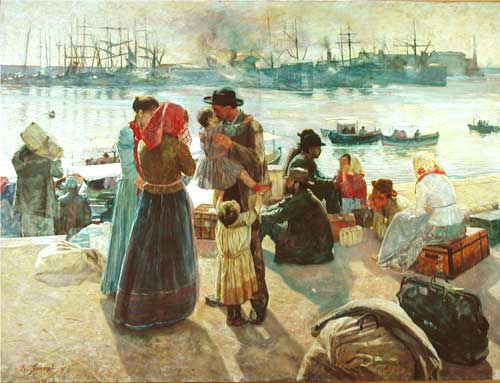
The poverty in Italy in the 1800's caused mass 
emigration

So necessity being the mother on innovation, people started blending whatever they could to try and get the coffee they loved. And the blended all sorts of things to try and get a great coffee. Where before they had been able to relay on high quality coffee from the Dutch and Venetian importers, their choices where limited.

Add to this that at the same time the largest coffee growing regions started identifying that coffee grown in plantations rather than in highland forests suffered from coffee rust, and the coffee quality was been affected anyway.

So you have contributing factors:

  • Italy is at war with itself, the Austrians, and the French, rations and imports are limited in the first place
  • The quality of world wide coffee is being affected by the mass replanting of crops to be replaced by a lower quality but more robust distant cousin named Robusta, or Robusta Arabica cross breeds.
  • The coffee culture at this point was quite strong, the Austrians and Italians driving demand in main land Europe, feed by the Dutch and French importers
Now wonder all of the most establish blends of Italy come from this period. When I see that a company that claims to have been blending since this time, red flags go up and I think to myself what have these companies have a reference point?

Blends are a way of getting a similar tasted no matter what happens in the year before with regard to agricultural results. Perhaps we should be asking ourselves what are we voting for when we support these products with our money?

Is a crop ever the same year on year? No, blending is not an art of taste it is an art of marketing.

Saturday, October 22, 2011

Can an espresso filter change a brew?

I recently saw an advert for a machined espresso filter. I have always wondered how you can tweak and espresso machine, and seeing this is quite interesting. Can the size of the holes make that big a difference?

Well read what coffee geek had to say: (original link Can These Filters Change the World of Espresso?) VST Baskets Here is a summary.

Driven by an idea in a lecture VST redesigned the fitler basket to produce their own one, producing three different basket sizes. But it's not just the physical size of these baskets that are different: the holes, their size and placement are given extreme attention for each individual basket size. The four sizes are: :
  • 7 gram basket (still in development, not yet available);
  • the 14 gram basket (VST will call this a 15g basket, as it can hold 14-16g);
  • the 17 gram basket (VST ref 18g - can hold 17-19g);
  • and the 21 gram basket (VST ref 22g, holding 21-23g).


3 VST baskets
  1. One of the things learned was the value of around 1-2mm separation (depending on the type of coffee used, but leaning towards 2mm) from the top of the bed of coffee and the bottom of a dispersion screen. For many testers, this was deemed the optimum clearance to allow for full and complete saturation of the bed of coffee. The vertical depth of each basket is designed with this 2g max swing in weight while still hitting desired target extractions as shown with an ExtractMojo refractometer test and Mojo's Brewing Control Chart.
  2. Water flow through the bed of coffee was also exhaustively examined. Existing baskets, with a much smaller exit surface area vs a larger entry area on top for liquid often result in uneven, sometimes unpredictable extractions. The answer would be to maximize the bottom flat portion of the basket, with as many holes as possible to the edges. This is one thing the VST baskets do.
  3. Other baskets have inconsistent holes sizes, and this produces grinds in the espresso and blockages, so the VST baskets solve this through a patent-pending (and protected) manufacturing and testing process. Where most baskets have a wide spread of sizes for holes (sometimes as many as 200 different hole sizes in one filter), the VST baskets, by contrast, 3 to 5 hole size spread for almost every exit hole in the filter. They are just that uniform, and that leads to better, more even extraction possibilities.
The baskets do make a difference, but the also expose bad tamping techniques


Update:
Okay so they are not VST porta filter baskets but while in Seattle I picked up the Strada ones, one getting home, and making sure my tamp was correct, I was really surprised how a small difference can change so much, the espresso was much better extracted, crema at least 50% better, and the espresso tasted good.

So if you cannot lay your hands on the VST porta filter baskets, then try a La Marzocco agent and ask for their baskets. They really do improve the expresso you can pull.

Thursday, September 22, 2011

Why do some people drink milk and sugar in coffee?

Many things have come from war, not all of them bad. Funny place to start when talking about why we have a tradition of some cultures adding milk and sugar to their coffee.

Well the person who is often recognized as the person, who was coffee’s chief promoter of coffee in Europe Yuriy Kulchitsky, was originally a Cossack from Ukraine. Fought against the Turks and was captured. While he was captured he was introduced to coffee (the wine of the Turks/Arabs), and he also taught himself Turkish.

In the mid to late 1600’s he worked as an interpreter in Vienna. In 1683 Vienna was besieged by the Turks. Kulchitsky dressed in traditional Turkish apparel and was sent to request reinforcements from Emperor Leopold. These reinforcements assisted in the emancipation of Vienna, and Yuriy was hailed as a hero.

When the Turks retreated they left 300 sacks of coffee and these where given to the only person
interested in them Yuriy.

He started handing out coffee so that people could taste it, and driven by his passion decided to add milk and sugar to the coffee, so that more people would enjoy the coffee. This resulted in the opening of the first coffee shop in Vienna (one of the first in Europe, the Venetians lay claim to be the first).

If you visit Vienna there is a monument to Yuriy Kulchitsky and there is a street that bears his name. A rare honour for a lover of coffee, to have achieve such fame.

To this day coffee is still enjoyed in a Viennese style (with milk and sugar), although some traditionalist consider this sacrilege.

Tuesday, September 13, 2011

Coffee the biggest gainer in the Standard and Poors

Coffee was actually the biggest gainer in the Stan...: Last month Arabica futures rallied 20 percent on the news that frost in the Brazilian growing areas would negatively affect next year’s crop. Coffee was actually the biggest gainer in the Standard and Poors GSCI Index, and the GSCI was down 1.7 percent! Arabica Coffee had more than doubled in price since June of 2010. Rain had cut the output from Colombia, the second largest producer. And according to the U.S.D.A; Coffee stockpiles in Brazil were at their third lowest level in fifty years.

But if you look past this news, and read the additional information in the above linked article, you see that a momentary scare is all it is. The future looks like the coffee prices will decrease over the next 12 months with production in the major South American countries on the increase due to both weather and financial drivers.

Friday, July 29, 2011

Sensual coffee roasting

The Art and Craft of Coffee: An Enthusiast's Guide to Selecting, Roasting, and Brewing Exquisite CoffeeWhen you are serious about extracting the best for a high quality coffee, you need to roast considering many things. The two  most important senses are sight and smell. Yes there are electronic devices and timers and temperature gauges but the best roasters use those the most, and sound is an element too, since with sound you identify first crack (pop) and second crack (snap). Those are great guides to the point at which the coffee is roasted.

Imagine losing one of those sensors and still roasting? Well read this and it may open your eyes.